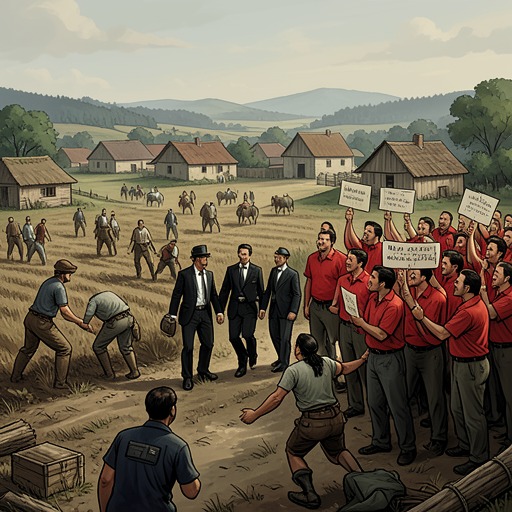
Fascist squad violence in Italy
M: Son of the CenturyFascist squad violence in Italy was a sustained political practice that moved from local intimidation and attacks on labor institutions to coordinated campaigns across the countryside and major towns. Its decisive effect was to dismantle much of the socialist movement’s local infrastructure, while presenting force as both the means to impose order and the proof of a promised national rebirth. The account stresses the contrast between the squads’ mobility and their opponents’ rooted institutions, and between public claims of restraint and the violence that made those claims politically useful.
Postwar crisis and rural conflict
The violence took shape amid a postwar landscape described as crowded with returning soldiers and emptied of confidence in the old political order. The prospect of five million veterans pressing back into civilian life sharpened the narrative’s sense of an unsettled country divided between those who belonged to the past and those who would claim the future. In this setting, fascism could cast itself as a movement of action, while the organized labor movement remained a substantial force rather than a defeated remnant.
The scale of that rival organization was especially visible in the countryside. In Emilia, socialists controlled 223 of 280 municipalities. Peasant leagues influenced hiring, work shifts, threshing, seed supplies, and crop planting; the account presents this reach as a system governing much of rural economic life. For laborers who might work only about 120 days a year, the leagues’ rules addressed the risks of seasonal unemployment and hunger. Their power also constrained landowners and those who accepted work outside collective agreements. This conflict over employment and land made rural communities a central arena in which political authority was contested.
Ferrara became a focus of that contest. The account describes socialist organization there as exceptionally extensive and traces the squads’ counteroffensive to the strength of the leagues and their influence over local life. The response was not simply rhetorical: it relied on armed groups, transport, concentration of force, and surprise. The punitive expedition launched from Ferrara on January 23, 1921, was planned against several peasant-league centers at once, with trucks supplied by the Agrarian Association. Its military organization distinguished it from a spontaneous street disturbance and made the countryside a deliberate target.
From raids to a campaign of destruction
During the spring, attacks spread through Ferrara and neighboring districts. On April 8, the employment bureau at Jolanda was burned and the local administration forced to resign. Two days later, after Arturo Breviglieri was killed during a raid in Pontelagoscuro, squad members occupied the town and destroyed its Chamber of Labor. On April 11, they attacked the Chamber of Labor in Granzette; on April 14, about a hundred squad members held Ferrara under siege for two days and stormed labor and community institutions. Umberto Donati was killed in Roncodigà after proposing a return to the Chamber of Labor. The actions continued against organizations in Bondeno, Gaibanella, and Ostellato.
The cumulative losses were institutional as well as personal. Within a few months, nine chambers of labor, a cooperative, and nineteen peasant leagues in Ferrara had been destroyed. The Chamber of Labor in Rovigo, associated with Giacomo Matteotti’s political formation, ceased to exist after repeated destruction. As local institutions fell, some peasant communities abandoned socialist organizations and joined fascist unions; others continued to resist and faced further attacks. In Codrea, members voted to resist, but violence against the meeting’s secretary was followed by peasants joining the local fascio. The narrative emphasizes how quickly intimidation could turn a public assembly into an occasion for capitulation.
This campaign depended on a different capacity from that of the organizations it attacked. Angelo Tasca’s analysis, as presented in the narrative, contrasts mobile squads—many made up of former Arditi or soldiers and led by officers—with workers tied to their land and to institutions built through long collective effort. The squads could move between targets and concentrate force; their opponents had more to lose in defending community centers, workplaces, and local gains. The image of the truck against the Casa del Popolo condenses this imbalance: mobile destruction confronting institutions whose strength had been built slowly through labor and attachment.
Military methods and political limits
The narrative also shows that squad violence could meet resistance. In one confrontation, an attempt by Amerigo Dumini to negotiate terms was rejected by the Carabinieri. A force of fifteen Carabinieri took position as the fascists advanced; firing followed, and the fascist formation scattered after encountering unexpected opposition. The exchange interrupted the assumption of easy victory. It demonstrates that the squads’ power rested not only on their willingness to use force but also on circumstances that allowed them to overwhelm less mobile opponents without facing a coordinated state response.
The violence created a political problem for Benito Mussolini. Moderate voters could be reassured by the promise of order and alarmed by the squads’ attacks. After killings in a schoolyard and in Foiano, the narrative describes Mussolini using a two-sided public approach: he praised reprisals against socialist violence while his newspaper characterized fascist violence as bounded and corrective. The contradiction was functional. Force could be presented as a remedy for disorder even as it produced new intimidation and destruction. In the account’s formulation, violence operated as both poison and antidote, depending on who applied it and how its effects were described.
The conflict over how to control the movement became especially visible in the preparations for the occupation of Ferrara. With Benito Mussolini’s authorization, Italo Balbo circulated detailed instructions for mobilization. The orders prohibited beatings and alcohol and barred visits to brothels, indicating an effort to impose discipline on the operation. At midnight on May 11, thousands of impoverished farm laborers began moving toward Ferrara on foot, by bicycle, in wagons, and on barges. The next morning, about fifty thousand entered the city. Telephone lines were cut, schools requisitioned for accommodation, and shops and businesses ordered closed. The mobilization turned rural numbers into an occupying force and left the city paralyzed. Its scale made clear that squad power could be built not only through small armed expeditions but through the organized movement of a mass following.
National escalation and the promise of rebirth
In July, a twenty-four-hour expedition across towns and countryside in the provinces of Forlì and Ravenna extended the campaign beyond local targets. The march began on July 29 and passed through Rimini, Santarcangelo, Savignano, Cesena, and Bertinoro. The account records nine deaths in the surrounding area before the expedition moved on and describes destruction across the plain. When news reached Rome, negotiations with socialists stopped. The Labor Alliance then proclaimed a general strike, presenting it as a united defense of political and union liberties. A premature newspaper disclosure disrupted the plan, and the government changed course before the strike began.
After the strike was called off on August 4, the squad offensive continued. Hundreds of cooperatives, associations, and chambers of labor were destroyed across the country, and socialist administrations resigned. On August 12, Benito Mussolini flew over Italy and could still see smoke in Tuscany, Emilia, and the lower Po Valley. The scene marks not a pause after the strike but the completion of a broader assault: the movement’s opponents had lost the organizations through which they had sustained local political life.
The account sets this material record against fascism’s language of national renewal. At the founding of the National Fascist Party, Benito Mussolini described fascism as a synthesis capable of absorbing liberalism after violence had buried earlier methods; he linked national unity, empire, state power, and the conquest of the masses. Elsewhere, the movement’s ascent is figured as a passage from a handful of followers to legions, from decline to youth and resurrection. The spectacle of rebirth therefore stands beside the destruction of rival institutions. Fascist squad violence mattered both as coercion on the ground and as part of a political story in which force was made to appear the instrument of unity, order, and a new national beginning.